
Choosing the Right Model for the Job
How we built a repeatable evaluation framework to compare models, test real agent workflows and make better engineering decisions.
Choosing a model is the most visible decision in an AI project, but rarely the only one that matters.
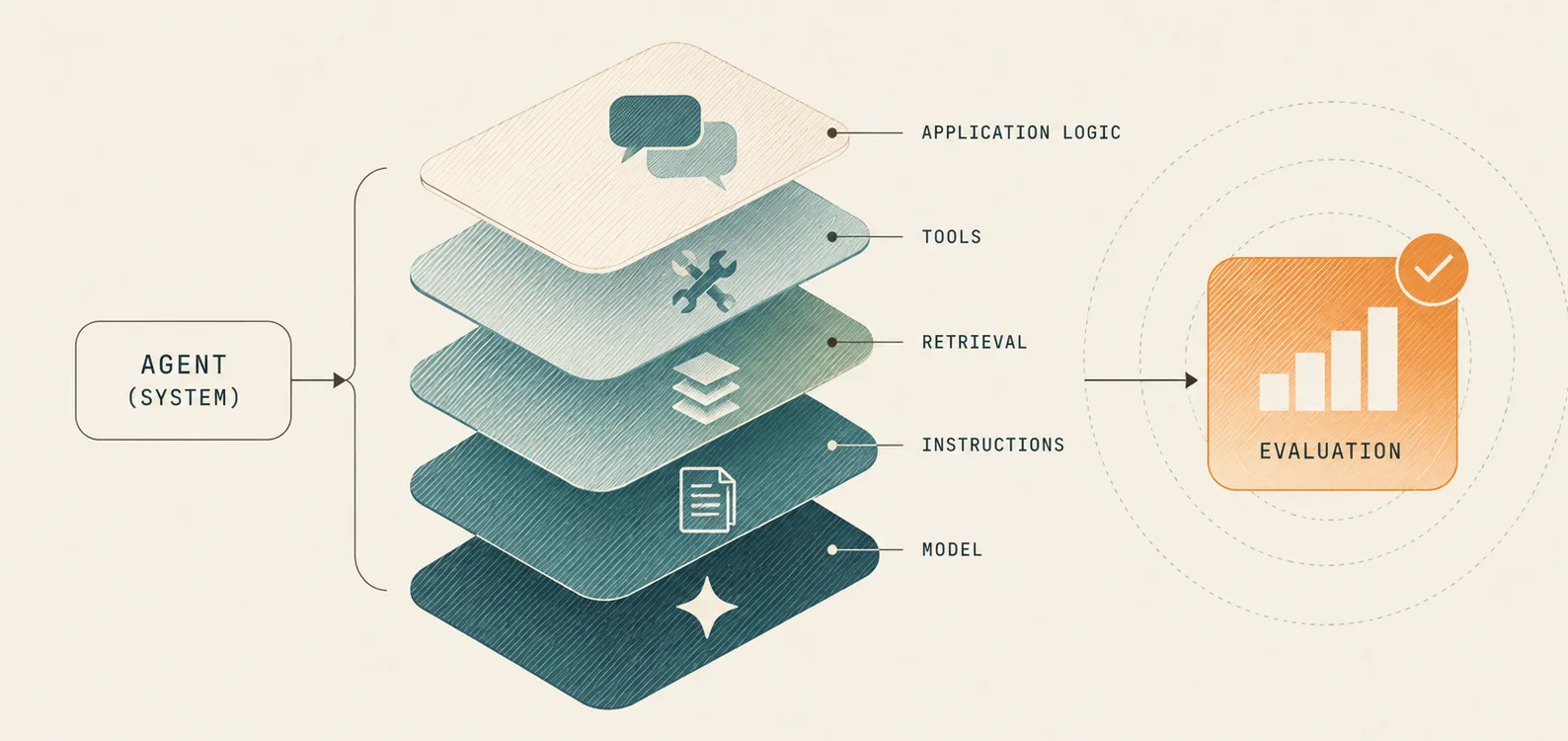
A deployed agent is a system. Its behaviour depends on the model, but also on the instructions it receives, the information it can retrieve, the tools it can use and the application logic connecting everything together. A stronger model does not automatically make every part of that system better. Nor does every task need a large language model. Some require reasoning and flexibility; others are better handled by deterministic rules, structured workflows or conventional software.
The engineering challenge is to understand which approach fits each task, then test how the complete system behaves under realistic conditions.
We built runthrough, an open-source extension to Inspect AI, to do exactly that. We used it to run 324 simulated conversations across four models, compare quality and cost, and establish a repeatable way to evaluate a deployed agent beyond the model benchmark.
The experiment reinforced a principle that guides our work at Meridian: model selection, system design and evaluation need to be considered together.
01Why evaluate the entire agent?
A model benchmark tells you how a model performs on a defined set of tasks. It does not tell you how your agent will behave when its own instructions, retrieval system, tools and application logic are involved.
That distinction matters as agents take on more complex work. A prompt may contain dozens of operational rules. A tool may return information that changes what the agent should say next. A knowledge source may be updated. A model may follow the instruction correctly in one conversation and interpret it differently in another.
Manual testing remains useful for exploring behaviour, but it is difficult to compare changes consistently or assess how often a particular outcome occurs. A repeatable evaluation makes those comparisons possible.
We wanted to test the deployed system through its real HTTP endpoint, with the same prompts, tools, retrieval and streaming behaviour used by the application. Most evaluation frameworks focus on models. We needed a way to evaluate the agent as a whole.
That led us to build runthrough, a small extension to Inspect AI that treats a deployed agent as a system under test and interacts with it as a user would. We have released it as open source.
02How runthrough works
The process is straightforward: define realistic scenarios, simulate conversations, send them to the deployed agent, record what happens and score the results against explicit criteria.
Scenarios that reflect real tasks
Each evaluation starts with a YAML scenario describing a user, their goal and the behaviours being tested. Our set contained 27 scenarios covering information requests, retrieval, scheduling, tool use, human escalation, multilingual interactions and off-topic or adversarial requests. The scenarios were designed to test specific requirements, not simply whether an answer sounded helpful.
- id: scheduling-request
  persona: >
    A user comparing available services.
    They want to arrange a suitable time.
  goal: Complete the scheduling request.
  max_turns: 5
  expect:
    tools_called: [availability_check]
    rubrics: [rubrics/clear-confirmation.md]
Simulated conversations, real agent
A separate model plays the user one message at a time, responding to the agent's replies as a person plausibly would. Each conversation runs until the goal is met or a turn limit is reached. We repeat every scenario so the evaluation captures more than one possible interaction.
Messages are sent to the agent's actual endpoint. Its real system prompt, tools and retrieval run as they do in the deployed application. runthrough records each reply, tool call, tool result and the token usage reported by the agent.
Consistent scoring
Some behaviours can be checked mechanically, such as whether a required tool was called or whether the reply used the requested language. Other criteria are assessed by an LLM judge using short, explicit rubrics. The judge sees the full transcript, including tool results, so it can assess not only what the agent said but also the evidence available to it.
Automated evaluation needs its own validation. Before the full run, we compared our lower-cost judge, gpt-5-mini, with a stronger model on pilot conversations. They agreed on 11 of 12 verdicts. runthrough also includes a simple labelling interface for human reviewers to score samples and compare their judgements with the automated evaluator.
03The experiment: four models, one system
We ran the same 27 scenarios three times against four OpenAI models: 81 conversations per model and 324 in total. The deployed agent, prompts, tools and retrieval setup remained the same. Only the model changed.
| Model | Reasoning effort | Price per 1M tokens (USD): input / cached / output | Role in comparison |
|---|---|---|---|
| gpt-4o-mini | Not a reasoning model | 0.15 / 0.075 / 0.60 | Baseline |
| gpt-6-luna | Low | 0.10 / 0.01 / 0.50 | Lowest-cost option |
| gpt-5.4-mini | None | 0.75 / 0.075 / 4.50 | Small-model comparison |
| gpt-6.1-terra | Low | 1.00 / 0.05 / 5.00 | Higher-capability comparison |
Prices reflect OpenAI standard-tier pricing at the time of the run. Conversation cost includes the agent's own token usage, as reported for each reply. Simulated-user and evaluator tokens are excluded.
We kept the experiment repeatable and economical. The simulated user was gpt-4.1-mini. The judge was gpt-5-mini with low reasoning effort. Results were saved after each conversation, allowing an interrupted run to resume without starting over.
04Results: quality and cost both matter
gpt-6.1-terra achieved the highest score, passing 91% of checks. gpt-6-luna passed 84%, at approximately one-sixth of terra's cost. gpt-4o-mini passed 61%, while gpt-5.4-mini passed 78%.
The result illustrates why selecting a model is an engineering decision, not a leaderboard exercise. Terra delivered the highest score, but Luna achieved a strong result at a substantially lower cost. For this workload, the additional seven percentage points did not justify a sixfold increase in cost.
Cost was also shaped by prompt caching. Input represented more than 98% of tokens, and the GPT-6 models served 89–93% of that input from cache, compared with 82% for the other models. This helped explain why terra cost less per conversation than gpt-5.4-mini despite its higher list prices.
The GPT-6 models were about one second slower per reply. None exceeded 10 seconds at the 95th percentile. For this workload, that difference was acceptable.
05What the results tell us about system design
The model comparison was one part of the exercise. The wider value came from seeing how the system's components performed together and identifying where different engineering approaches were appropriate.
A useful evaluation should distinguish between model capability and system behaviour. If an agent gives an incorrect answer, the cause might be the model's reasoning, an unclear instruction, incomplete retrieved information, a tool contract or an application-level rule. The response should not automatically be to choose a larger model.
Some tasks benefit from a model's ability to interpret context and handle variation. Others should be constrained by deterministic logic. For example, calculations, eligibility checks, permission rules and state transitions are often better handled by application code, with the model explaining the result rather than deciding it.
The same principle applies to tools. A model can decide when a tool is relevant, but the application should define what the tool is allowed to do, validate its inputs and return an explicit outcome. The agent's response should reflect that outcome.
This is why we evaluate the full workflow. It helps us determine which parts need stronger model capability, which need clearer instructions, and which should be handled outside the model altogether.
Choosing the right model for the task
gpt-6.1-terra was the top scorer, but gpt-6-luna achieved 84% at about $3 per 1,000 conversations, compared with approximately $20 for terra. Luna's score was close enough for this workload that the cost difference mattered more than the additional performance. We selected Luna and added a reasoning-effort setting to the agent configuration, making future model changes a configuration decision rather than a code change.
Keep evaluation aligned with the system
Evaluation scenarios and rubrics need to reflect the current product, data and workflows. As these change, the tests should change with them. A test suite is most useful when it evolves alongside the agent it measures.
Validate the evaluator
An automated judge can make mistakes, too. We compare its decisions with human-reviewed samples and inspect transcripts when a result looks unexpected. Scores are useful only when the criteria are clear and the evaluator applies them consistently.
The goal is not to use the most capable model for every task. It is to build a system in which each task is handled by the approach best suited to it, then evaluate the result as a whole.
06A repeatable engineering practice
The experiment gave us more than a model recommendation. It established a repeatable way to compare model choices and examine the complete agent under consistent conditions.
We use evaluation to inform decisions about model selection, prompts, tools and workflows. It helps us understand where additional model capability creates value, where deterministic logic is more appropriate, and where the surrounding system needs to be made clearer or more robust.
This matters because the available capabilities keep changing. New models arrive, pricing shifts and performance improves. A system that is evaluated regularly can take advantage of those changes without relying on assumptions or headline benchmarks.
runthrough, the harness behind this experiment, is open source on GitHub. If your agent is available behind an HTTP endpoint, you can define scenarios in YAML, run simulated conversations and inspect the scored results in Inspect's log viewer.
Building confidence in an AI agent requires testing the entire system. That means evaluating the model, the instructions, the tools, the data and the workflows together, then choosing the right approach for each task.
For us, that is part of delivering AI systems that perform well in practice: not simply choosing a model and moving on, but applying the engineering discipline to measure, understand and improve the system as a whole.


Start a conversation.
- Middle East
- Europe
- LatAm